Laurie's Blogs.

Nov 2026
Back Pain and Myofascial Contributors in Working Dogs: What the Evidence Means for Canine Rehabilitation
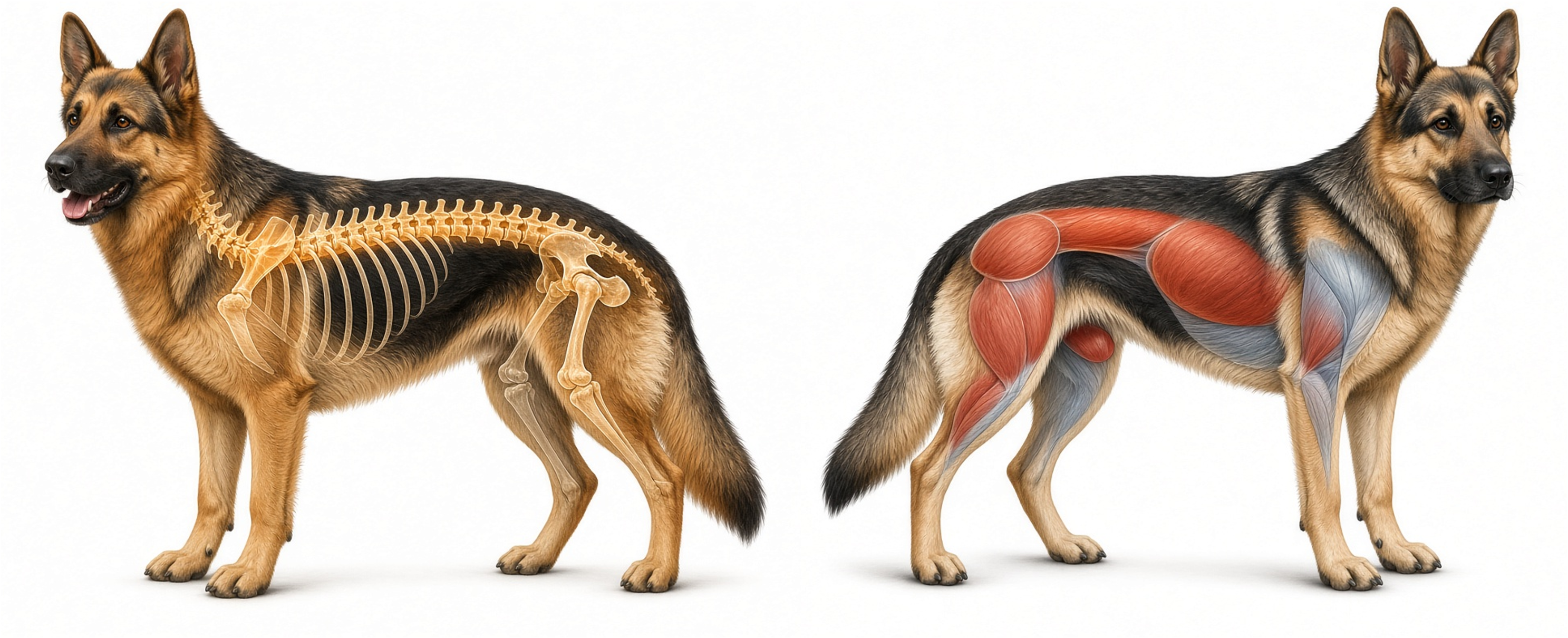
Working dogs—police, military, search-and-rescue, and other high-drive canines—face unique physical demands that place substantial repetitive load on the thoracolumbar and lumbosacral spine, associated muscles, and the pelvic limbs. Early retirement or loss from service due to musculoskeletal pain remains a persistent concern for handlers (and rehabilitation professionals). Four unique studies highlight both structural spinal issues and under-recognized myofascial contributions that can impair performance, contribute to chronic discomfort, and shorten working careers.
A survey of New Zealand police German Shepherd dogs found that the nominal retirement age of 8 years was reached by only 40% of dogs (Worth et al., 2013). The mean age at loss from service was 6.6 years. The single most important cause of retirement was inability to meet the physical demands of the job (65% of retired dogs). Degenerative musculoskeletal disease was the primary factor in 69% of those cases. When retired and euthanized dogs were considered together, 27% were lost due to back/spinal problems, with a high proportion believed to involve the lumbosacral joint. Hip-related arthritis was also common. The authors called for targeted research into factors predisposing to degenerative musculoskeletal and lumbosacral disease in order to extend working life.
Similar patterns appear in military working dogs. A retrospective review of 927 cases found that the leading causes of death or euthanasia included appendicular degenerative joint disease (19.2%), neoplasia (18.3%), and spinal cord–cauda equina disease (15.6%) (Moore et al., 2001). German Shepherd Dogs carried nearly twice the risk of death associated with spinal cord diseases compared with Belgian Shepherd Dogs. These findings underscore that spinal and pelvic limb degenerative conditions are not incidental but major drivers of end-of-career outcomes in working populations.
Beyond structural pathology, myofascial trigger points (TPs) represent a potentially modifiable source of pain and performance limitation. In a preliminary study of 12 active police working dogs performing approximately 6 hours of intense physical activity per day and free of radiographic or clinical comorbidities, every dog had at least one TP (average of 6 per dog) (Formenton et al., 2023). The highest percentage occurred in the lumbar portion of the longissimus dorsi (42% on the right), followed by latissimus dorsi, pectineus, quadriceps femoris, and sartorius (each 33% on the right). Overall, 44% of TPs were located in spinal muscles and 47% in hind-limb muscles, with a right-sided predominance (58%). The authors noted that repetitive high-intensity activities, obstacle work, and asymmetric positioning relative to the handler may contribute to microtrauma, fatigue, and ischemia that favor TP formation. Myofascial pain of this type may contribute to chronic lower-back discomfort and reduced performance long before overt radiographic changes appear.
A related study examined myofascial trigger points in 35 dogs with osteoarthritis (Formenton et al., 2025). Eighty-six percent of the dogs had at least one TP (total 177 TPs). The most frequently affected muscles were the longissimus thoracicae (40–43%), quadriceps femoris (31–40%), and longissimus lumborum (20–23%). Age was positively correlated with the number of muscles affected by TPs, yet there was no significant correlation between the number or location of osteoarthritic joints and the presence of TPs. Most TPs were again concentrated in the back (54%) and hind limbs (36%). These data suggest that TPs are common in dogs with osteoarthritis and may reflect compensatory overload, central sensitization, or independent myofascial dysfunction rather than simple local referral from the affected joint. For working dogs that also develop age-related or activity-related osteoarthritis, the combination of joint pathology and widespread myofascial pain can further compromise spinal stability, gait efficiency, and willingness to perform demanding tasks.
Implications for Canine Rehabilitation Practice
Routine palpation for taut bands and pain responses in the epaxial musculature (especially lumbar longissimus), latissimus dorsi, and key pelvic-limb muscles should form part of the musculoskeletal examination of working dogs, even when radiographs are unremarkable or the dog is still in active service. Identification of active TPs allows targeted interventions—manual soft-tissue techniques, dry needling where permitted and trained, laser, or shockwave—to be layered onto a broader program.
Early detection of subtle performance declines—reluctance to jump, shortened stride, reduced drive, or mild postural changes—should prompt a full axial-skeleton and soft-tissue assessment rather than waiting for overt lameness or neurologic deficits. Better yet would be routine physical examinations by a canine rehab practitioner trained to identify and treat back pain and myofascial pain. Collaboration with veterinarians for appropriate imaging and medical management of concurrent osteoarthritis or lumbosacral disease remains foundational, while rehabilitation focuses on restoring muscle function, reducing myofascial pain, and optimizing movement quality.
These studies collectively demonstrate that back pain in working dogs is multifactorial. Structural degenerative conditions remain major causes of career-ending impairment, yet myofascial trigger points are prevalent even in clinically sound, highly active dogs and in those with osteoarthritis. Systematic screening and proactive soft-tissue and load-management strategies offer practical avenues to support performance, comfort, and longer working careers.
References
Formenton, M. R., Fantoni, D. T., Gauthier, L., Cachon, T., Yeng, L. T., & Portier, K. (2025). Prevalence and location of myofascial trigger points in dogs with osteoarthritis. Frontiers in Veterinary Science, 12, 1488801. https://doi.org/10.3389/fvets.2025.1488801
Formenton, M. R., Portier, K., Gaspar, B. R., Gauthier, L., Yeng, L. T., & Fantoni, D. T. (2023). Location of trigger points in a group of police working dogs: A preliminary study. Animals, 13(18), 2836. https://doi.org/10.3390/ani13182836
Moore, G. E., Burkman, K. D., Carter, M. N., & Peterson, M. R. (2001). Causes of death or reasons for euthanasia in military working dogs: 927 cases (1993–1996). Journal of the American Veterinary Medical Association, 219(2), 209–214. https://doi.org/10.2460/javma.2001.219.209
Worth, A. J., Sandford, M., Gibson, B., Stratton, R., Erceg, V., Bridges, J., & Jones, B. (2013). Causes of loss or retirement from active duty for New Zealand police German shepherd dogs. Animal Welfare, 22*2), 167–174. https://doi.org/10.7120/09627286.22.2.167