Laurie's Blogs.

Nov 2026
Physiotherapy Modalities and Techniques for Canine Hip Osteoarthritis: What the Evidence Supports
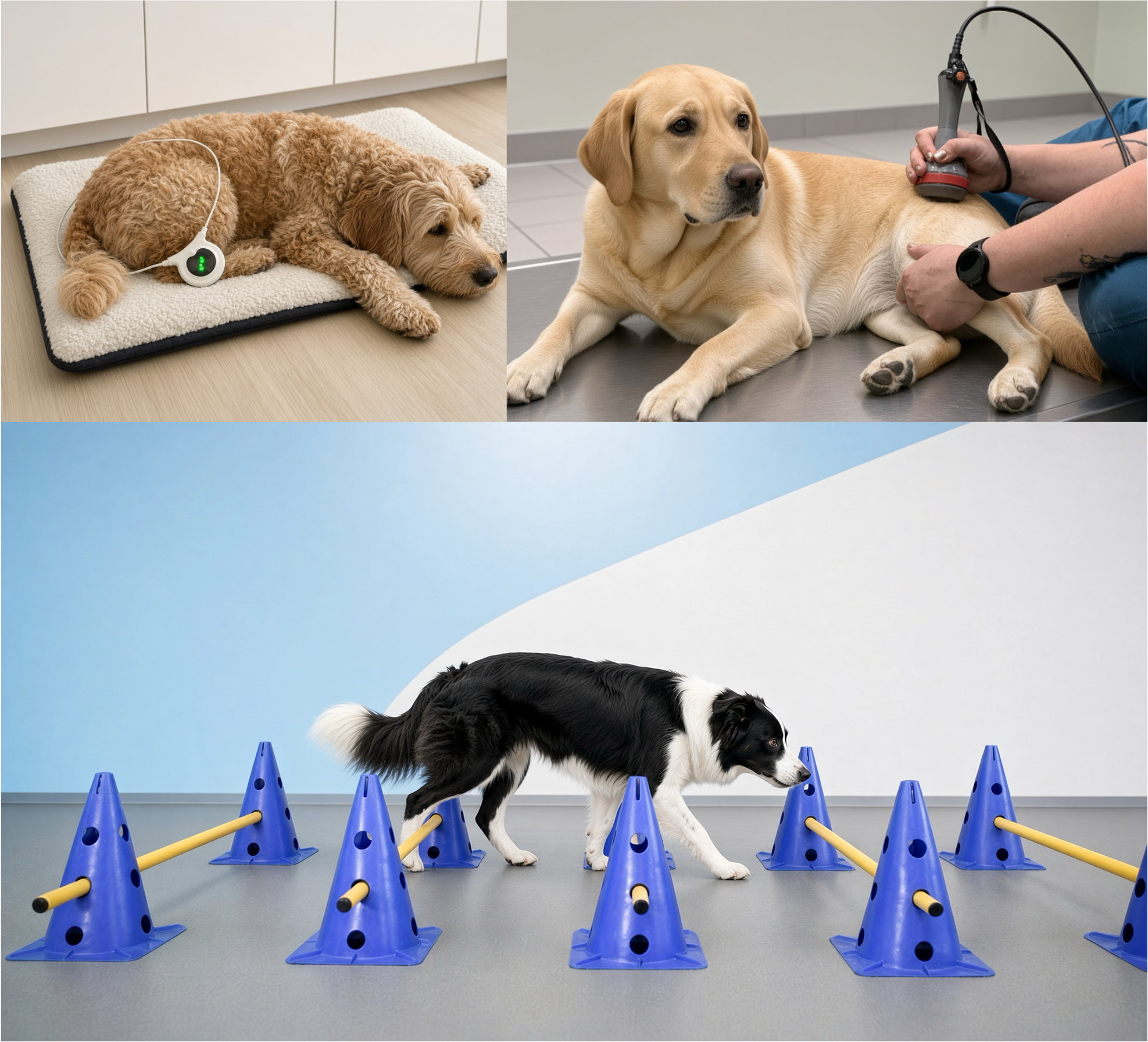
Hip osteoarthritis is a common problem in the dog population. It is responsible for declining mobility and a reduced quality of life. While pharmacological options remain part of the conversation for many cases, a growing body of work continues to support the practical value of physiotherapy modalities and techniques—used either as primary tools or as strong complements within a multimodal plan (Mille et al., 2023).
Recent studies focused specifically on canine hip osteoarthritis have examined two modalities that many of us already have in our tool kit: photobiomodulation (PBM / therapeutic laser) and pulsed electromagnetic field therapy (PEMF). In one randomized trial comparing Class IV photobiomodulation to a short course of meloxicam in dogs with moderate-to-severe hip osteoarthritis, the PBM group showed earlier and more sustained improvements across owner-reported pain and function measures, as well as gains in joint range of motion that persisted well beyond the treatment period (Alves et al., 2022).
Pulsed electromagnetic field therapy has also been examined as a standalone intervention. In a randomized trial of dogs with radiographically confirmed hip osteoarthritis, twice-weekly PEMF sessions produced significant reductions in pain thresholds and owner-reported pain scores (CBPI and Helsinki Chronic Pain Index) relative to untreated controls. Improvements were detectable early and held through the treatment period (Kühl et al., 2025). A separate pilot comparison of PEMF versus an NSAID found PEMF to be non-inferior, with earlier gains in pain and lameness scores and a positive trend in muscle circumference—again without reported adverse effects (Sassaroli et al., 2026).
These findings sit alongside a broader physiotherapy program study in which dogs with hip osteoarthritis received hyaluronic acid plus a structured regimen of massage, electrophysical modalities, and exercises. That group demonstrated greater reductions in pain intensity and lameness scores, plus measurable increases in thigh muscle mass, compared with hyaluronic acid alone (Altınkaya et al., 2024). A related program evaluation similarly showed greater gains in hip extension, walking performance, and CBPI scores when physiotherapy was added to hyaluronic acid (Altinkaya et al., 2025). The pattern is consistent: when targeted physiotherapy tools are added, objective and functional outcomes improve beyond what the comparison intervention achieves on its own.
Clinically, this supports a practical toolkit that can be tailored to the individual dog:
• Photobiomodulation: Useful for modulating local inflammation and pain, with protocols typically involving repeated sessions over several weeks. Evidence suggests benefits can extend beyond the active treatment window (Alves et al., 2022).
• Pulsed electromagnetic field therapy: A non-invasive option that appears effective for pain reduction in hip osteoarthritis, whether used alone or alongside other measures. Session parameters in the positive trials commonly involved 30-minute applications at modest field strengths, delivered two to three times weekly (Kühl et al., 2025).
• Therapeutic exercise and manual techniques: Strengthening, controlled range-of-motion work, soft-tissue mobilization, and proprioceptive exercises address the muscle atrophy, stiffness, and altered movement patterns that commonly accompany hip osteoarthritis. These remain foundational and are supported by the program-based trials above (Altınkaya et al., 2024; Altinkaya et al., 2025).
• Environmental and lifestyle adjustments: Weight management, flooring modifications, controlled activity, and owner-delivered home exercises continue to amplify the effects of in-clinic modalities (Mille et al., 2023).
One consistent gap across these studies is the limited direct comparison of comprehensive physiotherapy approaches used entirely independently of pharmaceutical or biologic agents. Most trials evaluate modalities against medication controls, as add-ons to medication, or in combination with injectables (Cidral et al., 2026; Alves et al., 2022). While this still demonstrates clear additive or alternative value, it leaves open the practical question of how far a well-designed rehabilitation program can carry a patient when drug options are limited, contraindicated, or simply not the preferred first step. That question is highly relevant for the dogs we see whose owners prefer, or whose medical status requires, a stronger emphasis on non-pharmacological management.
The available evidence supports integrating photobiomodulation, pulsed electromagnetic field therapy, therapeutic exercise, and manual techniques into hip osteoarthritis plans (Mille et al., 2023; Alves et al., 2022; Kühl et al., 2025). These tools offer measurable improvements in pain and function, carry favorable safety profiles in the published trials, and can be adjusted to the dog’s severity, owner capacity, and concurrent conditions. As always, individual assessment guides the specific combination and progression. Larger, longer-term studies that further isolate the contributions of rehabilitation strategies will continue to refine how we prioritize and sequence these approaches.
Cheers,
Laurie
References
- Altınkaya N, Kavlak E, Özgencil FE, Çağatay S. Physiotherapy in dogs with hip osteoarthritis – effects on pain, muscle and lameness: a randomised controlled trial. Turk J Physiother Rehabil. 2024;35(2):198-205. doi:10.21653/tjpr.1329550
- Altinkaya N, Kavlak E, Özgencil FE. Efficacy of physiotherapy program on treatment in dogs with osteoarthritis: a randomized controlled trial. Turk J Vet Anim Sci. 2025;49(2):38-47. doi:10.55730/1300-0128.4369
- Alves JC, Santos A, Jorge P, Carreira LM. A randomized double-blinded controlled trial on the effects of photobiomodulation therapy in dogs with osteoarthritis. Am J Vet Res. 2022;83(8):ajvr.22.03.0036. doi:10.2460/ajvr.22.03.0036
- Cidral LO, Serighelli-Júnior G, de Souza SF, de Castro Vilani RGDO. Bedinvetmab, alone or in combination with photobiomodulation and pulsed electromagnetic field therapy, on pain and quality of life in dogs with hip osteoarthritis. Vet Res Commun. 2026;50(3):198. doi:10.1007/s11259-026-11133-3
- Kühl LF, Montiani-Ferreira F, Hummel J, et al. Pulsed electromagnetic field therapy for pain control in dogs with hip osteoarthritis: a randomized clinical study. Vet Res Commun. 2025;49(6):360. doi:10.1007/s11259-025-10939-x
- Mille MA, McClement J, Lauer S. Physiotherapeutic strategies and their current evidence for canine osteoarthritis. Vet Sci. 2023;10(1):2. doi:10.3390/vetsci10010002
- Sassaroli S, Dini F, Sisti V, et al. Pulsed electromagnetic fields vs NSAID therapy in canine osteoarthritis: a randomised comparative pilot study. Vet Med (Praha). 2026;71(3):106-116. doi:10.17221/54/2025-VETMED
- Barale L, Monticelli P, Adami C. Effects of low-level laser therapy on impaired mobility in dogs with naturally occurring osteoarthritis. Vet Med Sci. 2023;9(2):653-659. doi:10.1002/vms3.997