Laurie's Blogs.

Oct 2026
The Added Value of Physiotherapy Modalities in Managing Canine Hip Osteoarthritis Pain: Insights from a Recent Study
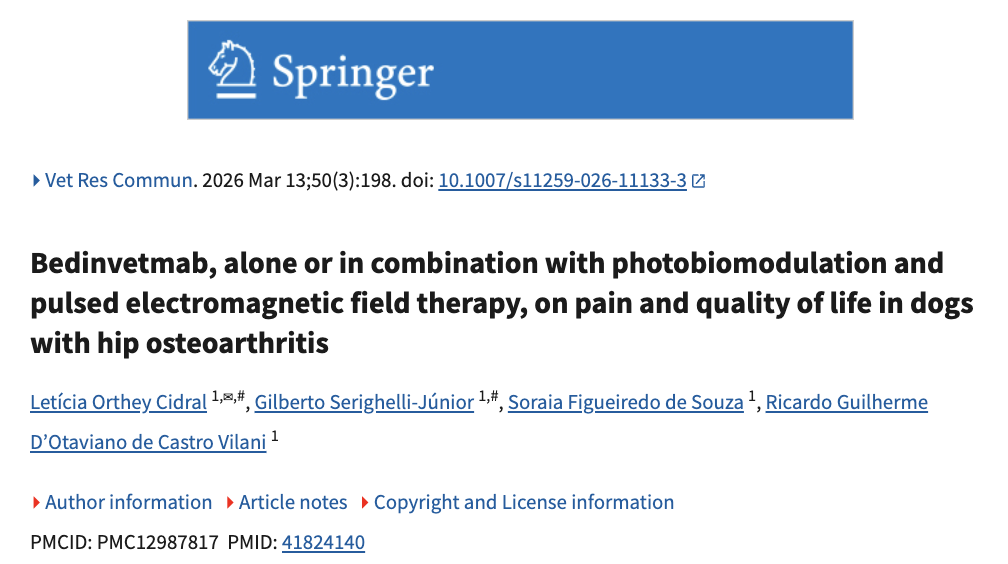
Before you think I’ve jumped on the Librela / Bedinvetmab band wagon, I have not. I am just reporting this study and adding my own commentary around it. Here we go!
Osteoarthritis continues to be a big pain in the butt (or elbow, or stifle or carpus, or hock, etc.)! Multimodal management is the standard we aim for—addressing pain, inflammation, muscle support, joint mechanics, and quality of life through a combination of strategies. A recent prospective, randomized study offers a look at how two physiotherapy modalities can complement pharmacological pain control specifically in dogs with hip osteoarthritis.
The paper, published in Veterinary Research Communications, evaluated bedinvetmab (aka Librela - a monoclonal antibody targeting nerve growth factor) used alone versus bedinvetmab combined with a physiotherapy program consisting of laser therapy and pulsed electromagnetic field therapy. Thirty dogs with radiographically and clinically confirmed hip osteoarthritis were divided into two groups. Both received bedinvetmab at regular intervals over a 90-day period. One group also received twice-weekly sessions of photobiomodulation (PBM, using an 808 nm laser) and pulsed electromagnetic field therapy (PEMF) applied to the hip region.
Pain and function were tracked with both owner-reported Canine Brief Pain Inventory (CBPI) scores and objective pressure algometry at the greater trochanter. Both groups showed meaningful improvement in pain severity, pain interference, and quality of life by the end of the study period. The combination group, however, demonstrated earlier gains on the objective algometry measures—detectable by day 15—and maintained a clear advantage from roughly day 30 onward through the later assessment points. Owner-reported quality-of-life ratings also tended to favor the dogs receiving the added physiotherapy.
These results align with what many of us see clinically: rehabilitation tools can provide complementary effects beyond what a single pharmacological approach achieves. Photobiomodulation and pulsed electromagnetic field therapy each have documented actions on inflammation, tissue repair processes, and pain modulation. When layered onto a medication protocol, they appear capable of producing more stable and earlier objective improvements in pain thresholds for hip osteoarthritis cases.
One notable design feature is the absence of a physiotherapy-only arm. The study compared bedinvetmab alone against bedinvetmab plus modalities; it did not include a group managed with PBM and PEMF (or other rehabilitation strategies) without the drug. That comparison would have been highly informative. As rehabilitation professionals, we routinely observe meaningful improvements in comfort, mobility, and owner-reported function using therapeutic exercise, manual therapy, modalities, and lifestyle modifications—sometimes as primary tools and sometimes alongside medications. Understanding the relative and independent contributions of these approaches remains an cavernous research gap.
The study authors appropriately note limitations including the modest sample size, 90-day duration, open-label design, and the fact that the two modalities were not isolated from one another. These are typical constraints in clinical veterinary research and do not diminish the practical takeaway that adding these specific physiotherapy tools produced measurable additional benefit on objective pain measures.
For those of us focused on canine rehabilitation, the findings reinforce the value of integrating non-pharmacological modalities into hip osteoarthritis management plans. They also underscore the importance of objective outcome measures alongside owner assessments, as differences between groups were clearer on algometry than on some of the subjective scores. Individual patient factors—including concurrent conditions, owner capacity for home exercise, and the full risk-benefit profile of any chosen intervention—continue to guide our recommendations.
This study provides preliminary support for a multimodal strategy that includes photobiomodulation and pulsed electromagnetic field therapy. Larger, longer-term trials that also examine rehabilitation approaches used independently would further clarify how best to sequence and prioritize the tools we already have available. In the meantime, the results offer another reason to keep physiotherapy modalities firmly in the treatment conversation for dogs with hip osteoarthritis.
Cheers,
Laurie
PS. I am still not a Bedinvetmab / Librela supporter. While I have not seen a Rapid Progressive Osteoarthritis cases (as are being reported in the literature), I have seen a large number of dogs that neurologically or systemically decline to the point of requiring euthanasia.