Laurie's Blogs.

Oct 2026
Stationary Jump Tests for Hind Limb Symmetry: New Data on a Potential Return-to-Sport Measure
When is a sporting dog functionally ready to resume higher-level activity after orthopedic or neurologic injury? Human sports medicine has established limb symmetry indices (often targeting ≥90% on strength and hop tests) as one benchmark within broader return-to-sport frameworks. For dogs, single-limb hopping is not feasible, so clinicians have long sought practical, sport-relevant alternatives that can reveal residual asymmetries not apparent at a walk or trot.
Researchers tested three versions of a stationary platform jump in healthy dogs to see if hind limb push-off symmetry could serve as an objective outcome measure.
What they tested
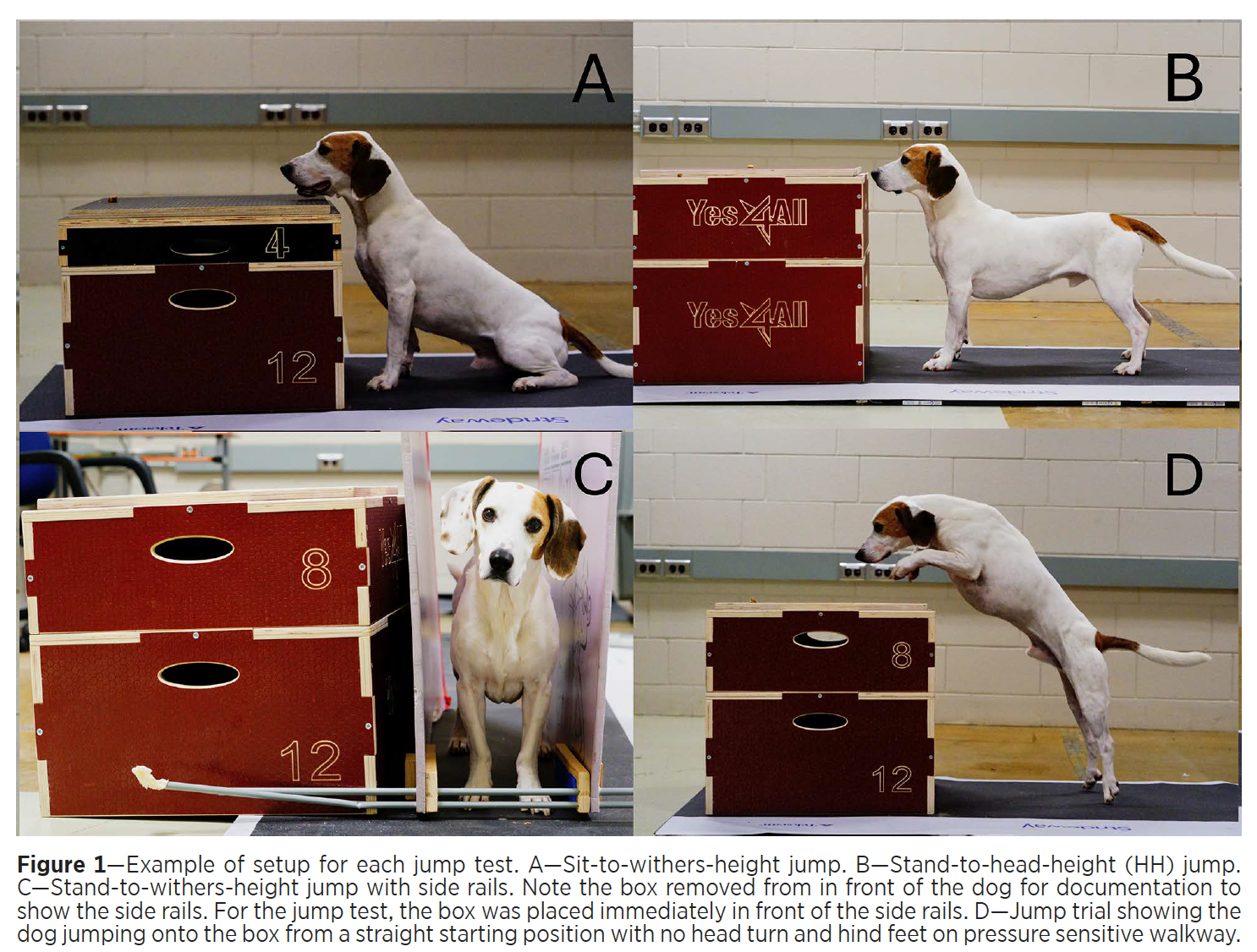
- Sit-to-withers-height jump
- Stand-to-head-height jump
- Stand-to-withers-height jump with side rails
20 sound dogs completed 5 valid trials of each. Peak vertical force was measured with a pressure-sensitive walkway and expressed as % symmetry.
Key results
- Average symmetry across 5 trials was below 90% for all tests:
- Stand-to-head-height: 83%
- Side rails: 73%
- Sit-to-withers: 67%
- High trial-to-trial variation within dogs
- No learning effect across trials
- Best single trial of the 5 for each dog exceeded 90% on every test:
- Stand-to-head-height: 97% (lowest variation)
- Sit-to-withers: 94%
- Side rails: 92%
Every dog produced at least one trial >90% symmetry on each test. The stand-to-head-height version looked most consistent.
How this fits with existing tools
FourLeg’s Return-to-Sport checklist already includes jumping onto a platform (higher than the dog’s height, 5–10 reps) as a functional test, plus slow-motion video analysis of sport-specific jumps to check movement quality, symmetry, and fatigue. This study adds kinetic data (peak vertical force symmetry) on the same general task.
What the authors note
- Average of 5 trials did not reach the hypothesized >90% symmetry
- Using the best of 5 trials may better capture a dog’s capacity for symmetry
- Stand-to-head-height showed the most potential among the options tested
- Further work is needed on sensitivity in dogs with injury, test refinement (positioning, surface, box size), and safety before clinical use
Full paper (open access): Dequaine & Gordon-Evans, AJVR, 2026. doi.org/10.2460/ajvr.26.03.0131