Laurie's Blogs.

Sep 2026
Part 1: Recognizing Canine Orthostatic Tremor
A two-part series for canine rehabilitation professionals
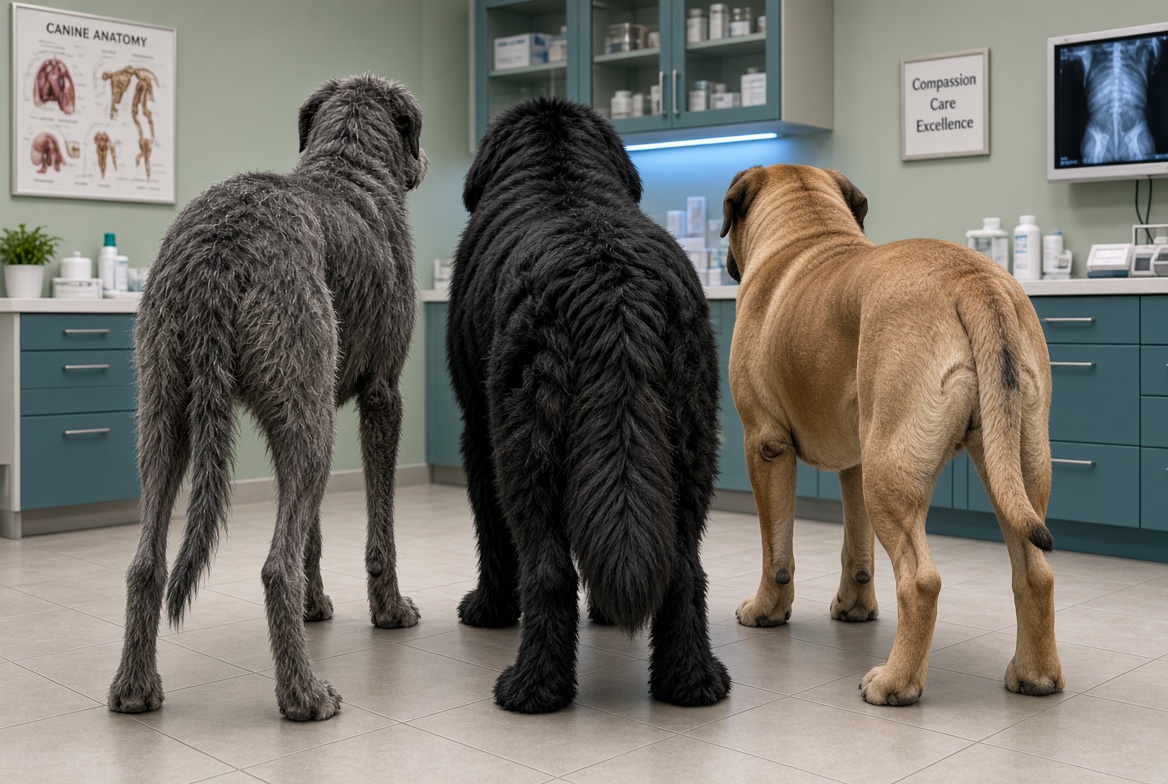
If a young Great Dane, Newfoundland, or Irish Wolfhound is referred for “hind-end weakness,” reluctance to stand still, or difficulty sitting and standing, the first thought is often orthopedic disease, cervical spondylomyelopathy, or deconditioning. Sometimes the problem is none of those. It may be orthostatic tremor (OT) — a rare movement disorder that is easy to mistake for weakness or pain (Liatis et al., 2022; Lowrie, 2021).
Rehab clinicians are often the first people to watch a dog stand still for more than a few seconds. That observation can change the plan. Part 1 covers what OT is, who gets it, how it looks on the floor, and how it is diagnosed. Part 2 covers medical treatment and what this condition means for rehab programming.
What is canine orthostatic tremor?
Orthostatic tremor is an action-related postural tremor. It produces high-frequency, involuntary, rhythmic, sinusoidal muscle activity that appears only while the dog is standing (bearing weight against gravity) and disappears when the dog walks, sits, or lies down (Liatis et al., 2022; Lowrie & Garosi, 2016).
The electrophysiologic hallmark is a conscious EMG discharge frequency greater than 12 Hz while standing, commonly 13–21 Hz. That frequency is faster than most other canine tremors and helps separate OT from shivering, essential tremor, or tremor secondary to paresis (Liatis et al., 2022; Lowrie & Garosi, 2016).
Two bedside signs are especially useful:
- Weight-bearing lifting test (WEBLT): lifting the dog so the limbs no longer support body weight reduces or abolishes the tremor.
- “Helicopter sign”: auscultation over a tremoring limb can produce a sound like a distant helicopter (Liatis et al., 2022; Burbaitė & Menchetti, 2023).
Tremors usually start in the pelvic limbs and may later involve the thoracic limbs, trunk, or, less often, the head. Dogs may look as if they are dancing in place or shivering constantly while standing. Gait itself is typically normal (Garosi et al., 2005; Lowrie, 2021).
Who gets it?
The largest published series included 60 dogs diagnosed by conscious standing EMG. Fifty-three had primary OT (POT); seven had OT-plus, meaning tremor plus another concurrent neurologic disease (Liatis et al., 2022).
Primary OT pattern:
- Almost exclusively purebred large and giant breeds (83% giant in that series).
- Most commonly reported breeds: Great Dane, Newfoundland, Irish Wolfhound, Mastiff, Scottish Deerhound, and Retrievers.
- Typical onset: young adulthood, often under 2 years of age (median around 12 months). Many dogs are 9–24 months old when signs begin.
- Retrievers are the exception. In the 2022 series they all developed signs after 3.5 years of age. Later-onset cases should raise suspicion for OT-plus or a different disease (Liatis et al., 2022).
Earlier reports described the same stance-locked tremor in Great Danes and a Scottish Deerhound (Garosi et al., 2005; Platt et al., 2006). A later JAVMA case documented primary OT in a 10-year-old Akita, showing that older presentation, while atypical, does occur (Burbaitė & Menchetti, 2023).
OT-plus has been seen with concurrent compressive myelopathy, vascular encephalopathy, or neuropathy. These dogs tended to be older, sometimes smaller-breed, and more likely to have tremors that were not strictly limited to standing (Liatis et al., 2022).
The condition is progressive in a majority of primary cases, but many dogs remain functional for years.
Clinical picture you will actually see
The most common presenting complaints in primary OT are:
- Pelvic-limb tremors while standing (85%)
- Difficulty rising or sitting down (45%)
Other owner reports include difficulty maintaining posture, reluctance to exercise, a wide-based stance, a “dancing” appearance, occasional head tremor, and apparent weakness (Liatis et al., 2022). Anxiety can exacerbate the tremor in some dogs. Tremor is generally absent during walking, trotting, and recumbency.
That last point is the trap. Because the dog looks unstable when standing still and struggles with sit-to-stand, owners and clinicians often conclude the dog is weak, painful, or myelopathic. The gait may look fine. The problem is stance, not stride.
How is it diagnosed?
Definitive diagnosis rests on:
1. Typical clinical pattern (high-frequency tremor while standing; absent when not weight-bearing)
2. Positive WEBLT
3. Conscious EMG while standing showing rhythmic discharges >12 Hz (Liatis et al., 2022; Burbaitė & Menchetti, 2023)
MRI and CSF analysis are used mainly to look for OT-plus or competing diagnoses, especially if onset is late, the neurologic exam is not otherwise normal, or the tremor is not strictly stance-locked. In primary OT, the neurologic examination is otherwise normal. Bloodwork is typically unremarkable aside from occasional mild CK elevation (Liatis et al., 2022).
Rehab professionals rarely perform an EMG, but they are well placed to document the history, request a standing-still video, and perform a careful WEBLT if it is safe.
What causes it?
The cause of primary OT is unknown. Human literature hypothesizes a central oscillator in the brainstem or cerebellum, with tremor expressed most when postural muscles are loaded. The same idea is used in dogs: a central generator whose output is gated by stance, spinal interneurons, and load-related afferent input (Liatis et al., 2022; Burbaitė & Menchetti, 2023). Because the disease can progress, a neurodegenerative process has been considered, but that remains unproven.
OT-plus is not a different tremor physiology so much as OT occurring alongside another neurologic lesion. The second disease may be coincidental or may unmask or modify the tremor.
Differentials that matter on the rehab floor
Consider OT against:
- Weakness or proprioceptive delay from myelopathy
- Pain-related trembling (orthopedic or spinal)
- Physiologic shivering
- Cerebellar or intention tremor
- Intoxication or metabolic tremor
- A “shaky” appearance from early osteoarthritis or deconditioning (Lowrie, 2021; Lowrie & Garosi, 2016)
The history is the giveaway: tremor only while standing, gone during walking and recumbency, and reduced by taking weight off the limbs.
Why Part 1 matters before you write a home-exercise plan
If you treat OT as simple weakness, you will default to prolonged static standing, long balance-board holds, and “stand square for 30 seconds” drills. Those tasks load the exact condition that triggers the tremor. Recognition comes first; programming comes second.
Coming in Part 2: medical treatment response, what rehab can and cannot change, and practical session design for sit-to-stand, gait work, and owner coaching.
References
- Burbaitė, E., & Menchetti, M. (2023). Difficulty walking and trembling in a 10-year-old female Akita Inu. Journal of the American Veterinary Medical Association, 261(6), 926–928. https://doi.org/10.2460/javma.23.01.0029
- Garosi, L. S., Rossmeisl, J. H., de Lahunta, A., Shelton, G. D., & Lennox, G. (2005). Primary orthostatic tremor in Great Danes. Journal of Veterinary Internal Medicine, 19(4), 606–609. https://doi.org/10.1892/0891-6640(2005)19[606:potigd]2.0.co;2
- Liatis, T., Gutierrez-Quintana, R., Mari, L., Czopowicz, M., Polidoro, D., Bhatti, S. F. M., Cozzi, F., Tirrito, F., Brocal, J., José-López, R., Kaczmarska, A., Cappello, R., Harris, G., Alves, L., Rusbridge, C., & Rossmeisl, J. H. (2022). Primary orthostatic tremor and orthostatic tremor-plus in dogs: 60 cases (2003–2020). Journal of Veterinary Internal Medicine, 36(1), 179–189. https://doi.org/10.1111/jvim.16328
- Lowrie, M. (2021). Guide to tremor and twitch syndromes in dogs and cats. In Practice, 43(1), 4–17. https://doi.org/10.1002/inpr.3
- Lowrie, M., & Garosi, L. (2016). Classification of involuntary movements in dogs: Tremors and twitches. The Veterinary Journal, 214, 109–116. https://doi.org/10.1016/j.tvjl.2016.05.011
- Platt, S. R., De Stefani, A., & Wieczorek, L. (2006). Primary orthostatic tremor in a Scottish deerhound. Veterinary Record, 159(15), 495–496. https://doi.org/10.1136/vr.159.15.495