Laurie's Blogs.

May 2026
Surgical vs. Conservative Management of Canine Medial Coronoid Process Disease (MCPD) / Medial Compartment Disease (MCD)
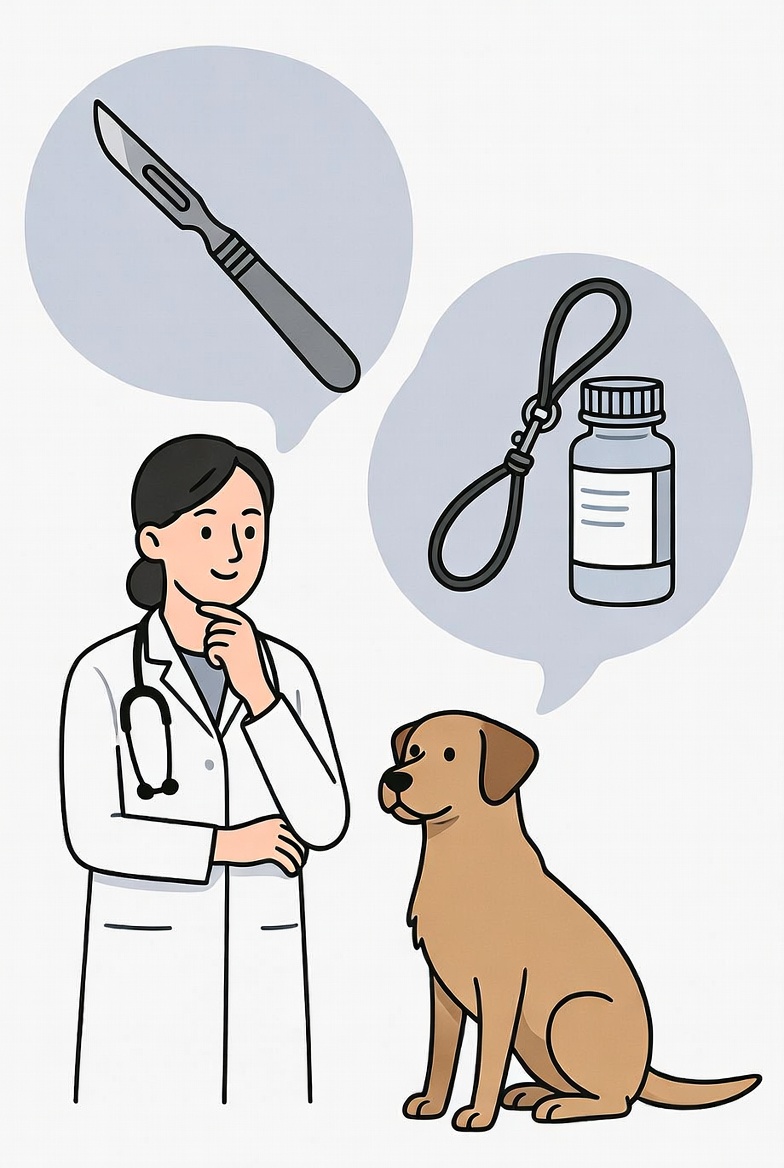
Veterinary orthopedic surgeons and small animal practitioners continue to face a common clinical dilemma: when a young, large-breed dog presents with elbow lameness due to fragmented coronoid process or broader medial compartment pathology, is arthroscopic (or open) intervention the best path forward, or can a well-structured conservative approach deliver comparable long-term results?
A 2023 systematic review and meta-analysis by Kähn and colleagues in Frontiers in Veterinary Science provides one of the most comprehensive syntheses to date on this topic. After screening 494 publications and applying strict PRISMA criteria, the authors included 14 clinical studies evaluating outcomes in dogs with confirmed medial elbow compartment disease. Their work highlights a consistent pattern: while surgery often yields high owner satisfaction and subjective clinical improvement in non-controlled studies, direct comparative evidence shows no clear long-term superiority of surgical intervention over conservative management.
Key Takeaways from the Systematic Review
The review grouped outcomes into three meta-analyses:
• Studies relying on clinical examination and owner questionnaires generally reported good-to-excellent results after fragment removal (with or without chondroplasty) via arthroscopy or arthrotomy.
• Objective gait analysis in pre–post surgical cohorts also demonstrated measurable improvement in forelimb loading symmetry.
• However, when the authors directly compared surgical and conservative cohorts in the available head-to-head studies, no statistically or clinically meaningful difference emerged in long-term limb function or lameness.
The authors emphasize that most included studies were of bronze or silver evidence quality (per Cochrane Musculoskeletal Group criteria), with inherent risks of observer bias in non-blinded designs. They conclude that, given the invasive nature of surgery and the current evidence base, a more cautious approach to routine surgical recommendation is warranted. Many dogs with MCD appear to achieve comparable functional outcomes with non-surgical care.
What Does “Conservative Management” Actually Look Like in the Comparative Studies?
Two key prospective and retrospective comparative papers—both included in the Kähn review—provide concrete details on effective conservative protocols. These are especially valuable because they used either objective gait analysis or validated owner-reported outcome measures, moving beyond subjective lameness scoring.
Burton et al. (2011) conducted a prospective clinical trial with inverse-dynamics gait analysis in 20 dogs with unilateral MCPD. Nine dogs were managed conservatively with:
• A 6-week course of the NSAID tepoxalin (10 mg/kg PO once daily).
• A structured, progressive exercise protocol: 1 week of strict room rest, followed by 5 minutes of lead exercise twice daily, increasing by 5 minutes per week for 2 months, then gradual return to normal activity at owner discretion.
This regimen produced improvements in total support moment and elbow moment that were statistically indistinguishable from the arthroscopic group at 6 and 12 months. Notably, the arthroscopic dogs showed greater mechanical asymmetry (i.e., more lameness) at the 4- and 8-week marks, suggesting a temporary worsening of function post-surgery.
Dempsey et al. (2019) evaluated long-term owner-reported outcomes (>12 months, median 56 months follow-up) using the validated Liverpool Osteoarthritis in Dogs (LOAD) questionnaire and Canine Brief Pain Inventory (CBPI) in 67 dogs with CT-confirmed MCPD. Twenty-three dogs received conservative management consisting of:
• Weight reduction targeted at dogs with body condition score ≥ 6/9.
• NSAID therapy for 6 weeks (with short-term paracetamol/codeine in some cases).
• Lead-restricted exercise for 8 weeks, followed by telephone or recheck guidance on long-term lifestyle modification.
Again, no long-term benefit was found for arthroscopic intervention (fragment removal, chondroplasty, or inspection only) compared with this conservative approach. Older age at diagnosis and at questionnaire completion was associated with higher (worse) scores across both groups, underscoring the importance of early intervention regardless of treatment modality.
Both papers illustrate that “conservative” does not mean “do nothing.” Effective medical management in these studies was multimodal, time-limited, and paired with owner-guided activity modification—elements that are practical in everyday practice and avoid the morbidity, cost, and recovery demands of arthroscopy.
Clinical Implications for Practice
For the practicing veterinarian or orthopedic specialist, the combined message from the systematic review and these supporting studies is clinically actionable:
• Surgery is not automatically superior. In appropriately selected cases, a structured conservative protocol can yield equivalent long-term functional and owner-perceived outcomes.
• Patient-specific factors matter. Consider age, body condition, severity of osteoarthritis on imaging, owner compliance, and financial/ethical considerations. Dogs with mild–moderate disease and owners willing to adhere to a controlled exercise and weight-management plan may be excellent candidates for initial conservative therapy.
• Expect OA progression. Neither approach halts radiographic osteoarthritis, but both can meaningfully improve quality of life.
• Client communication is key. Set realistic expectations: many dogs will never return to perfect symmetry on gait analysis, but most can achieve good function and comfort with either pathway.
Limitations and the Road Ahead
The evidence base remains limited by small sample sizes in comparative arms, variable surgical techniques, and the ethical/practical challenges of true randomization. Higher-quality, larger-scale prospective trials with standardized conservative protocols and longer follow-up are clearly needed. Until then, the Kähn review and the detailed data from Burton and Dempsey provide the strongest available guidance.
Bottom line: For many dogs with medial coronoid process disease, thoughtful conservative management—centered on short-term anti-inflammatory therapy, weight control, and progressive, controlled exercise—remains a reasonable, evidence-supported first-line option rather than a fallback. Surgery retains an important role in specific cases, but the data no longer support it as the default recommendation for every patient.
References:
Kähn H, Zablotski Y, Meyer-Lindenberg A. Therapeutic success in fragmented coronoid process disease and other canine medial elbow compartment pathology: a systematic review with meta-analyses. Front Vet Sci. 2023 Nov 9;10:1228497.
Burton, N. J., Owen, M. R., Kirk, L. S., Toscano, M. J., & Colborne, G. R. (2011). Conservative versus arthroscopic management for medial coronoid process disease in dogs: A prospective gait evaluation. Veterinary Surgery, 40(8), 972–980.
Dempsey, L. M., Maddox, T. W., Comerford, E. J., Pettitt, R. A., & Tomlinson, A. W. (2019). A comparison of owner-assessed long-term outcome of arthroscopic intervention versus conservative management of dogs with medial coronoid process disease. Veterinary and Comparative Orthopaedics and Traumatology, 32(1), 1–9.