Laurie's Blogs.

May 2026
The Relationship Between Medical Conditions and Cognitive Decline in Senior Dogs: Insights from a 2023 Study

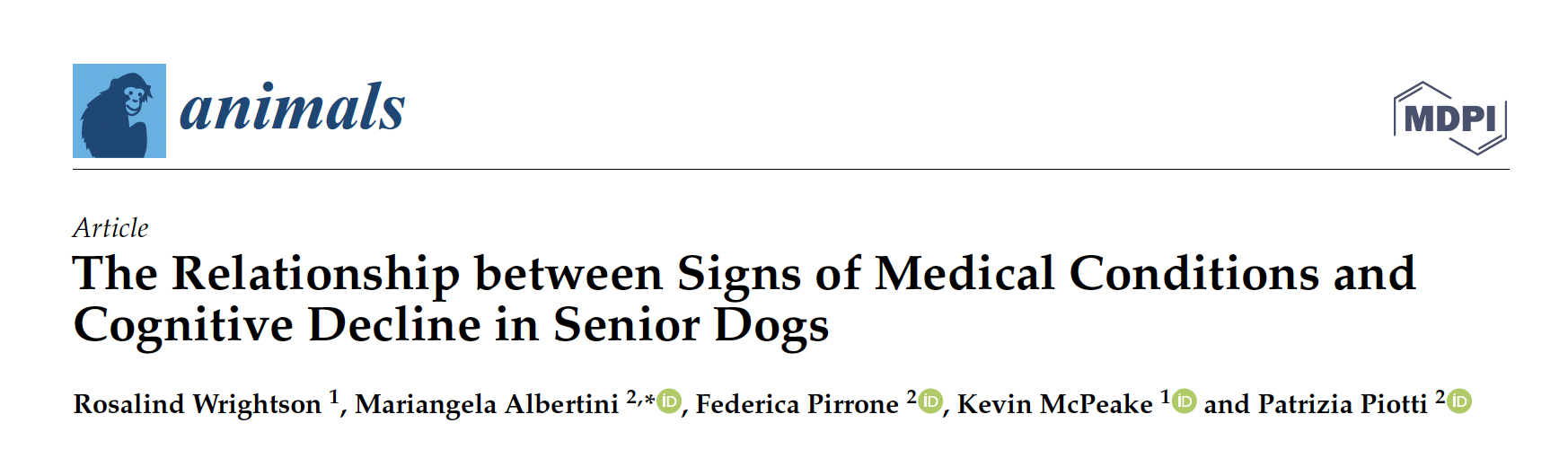
Veterinarians, canine behavior consultants, and practitioners working with geriatric patients frequently encounter senior dogs exhibiting behavioral changes that raise questions about canine cognitive dysfunction syndrome (CCDS). Distinguishing true neurodegenerative decline from overlapping medical conditions remains a key clinical challenge. A cross-sectional study published in Animals (2023) by Wrightson and colleagues provides practical data on this intersection, using owner-reported measures to explore how signs of concurrent health issues relate to cognitive impairment.
The researchers conducted an online survey targeting owners of dogs in the final 25% of their expected lifespan. Cognitive status was assessed with the validated Canine Cognitive Assessment Scale (CCAS), which captures changes across six behavioral domains: disorientation, sleep–wake cycles, social interactions, learning and memory, activity levels, and anxiety. Owners also reported on behavioral indicators of potential pathology in four body systems—musculoskeletal/neurological, digestive, metabolic, and dermatological—as well as any veterinary diagnoses received in the preceding year. Responses from more than 800 qualifying dogs formed the basis for analysis.

The results demonstrated clear patterns. Dogs showing greater cognitive impairment on the CCAS also exhibited more pronounced owner-reported signs of musculoskeletal and neurological compromise, including mobility difficulties, pain-related behaviors, and sensory decline (hearing and vision). A cumulative overall health score, reflecting the combined burden across systems, was likewise strongly associated with higher CCAS scores. Moderate associations emerged with digestive and metabolic signs, while dermatological indicators showed only a weak link. Veterinary diagnoses of musculoskeletal disease and dental disease further aligned with increased likelihood of cognitive impairment signs.
The study’s discussion is particularly valuable for practitioners because it moves beyond simple associations to consider potential underlying mechanisms. The authors propose several interconnected explanations, drawing parallels with human geriatric research:
• Chronic inflammation (“inflammaging”): Many of the identified conditions—musculoskeletal pain, certain digestive issues, and dermatological problems—involve sustained low-grade inflammatory processes that are increasingly recognized as contributors to cognitive decline in both species.
• Chronic pain as a confounder and potential driver: Behaviors classically associated with CCDS (e.g., house-soiling, reduced activity, apparent disorientation) can be direct manifestations of pain from musculoskeletal disease. The study notes that pain is frequently maladaptive and persistent, and evidence from veterinary behavior literature already links it to broader behavioral changes.
• Sensory impairment: Declines in hearing and vision loaded heavily onto the musculoskeletal–neurological factor. In humans, sensory loss is an established risk factor for cognitive impairment; similar patterns appear in dogs, where reduced sensory input can produce confusion, anxiety, or navigational difficulties that mimic neurodegenerative signs.
• Metabolic and systemic effects: Conditions such as diabetes or kidney disease can generate lethargy, house-soiling, and dull mentation that overlap with CCDS. Human parallels suggest vascular and inflammatory pathways may mediate these effects, underscoring the interconnectedness of body systems.
• Dental disease: A veterinary diagnosis of dental disease was specifically associated with cognitive signs, prompting the authors to reference emerging human data on periodontal pathogens and their possible role in neurodegenerative processes.
• Cumulative health burden (“frailty”): The overall health score showed one of the strongest correlations with cognitive impairment, echoing the human concept of frailty—a diminished resilience that manifests across both physical and cognitive domains.
Because the study is cross-sectional, it cannot establish causality. The observed relationships could reflect disease processes accelerating cognitive decline, shared risk factors such as age, or the non-specific nature of many CCAS items, which can be influenced by pain or sensory loss. The authors emphasize that CCDS remains a diagnosis of exclusion and urge thorough screening for treatable medical conditions—particularly painful ones—before attributing changes solely to neurodegeneration.
Clinical Takeaways
This work reinforces the importance of a comprehensive geriatric evaluation whenever cognitive changes are reported. Routine screening for musculoskeletal pain, sensory deficits, dental disease, and metabolic disorders may not only improve quality of life but also clarify the true contribution of CCDS. Early intervention on concurrent conditions can reduce caregiver burden and potentially slow the apparent progression of behavioral signs.
The full article is open access (DOI: 10.3390/ani13132203) and offers a useful framework for discussing these complexities with clients. In an aging canine population, recognizing the interplay between physical health and cognition equips us to provide more precise, whole-patient care.