Laurie's Blogs.

Mar 2026
Reviewing Kinesiology Taping's Role in Reducing Post-TPLO Swelling in Canines
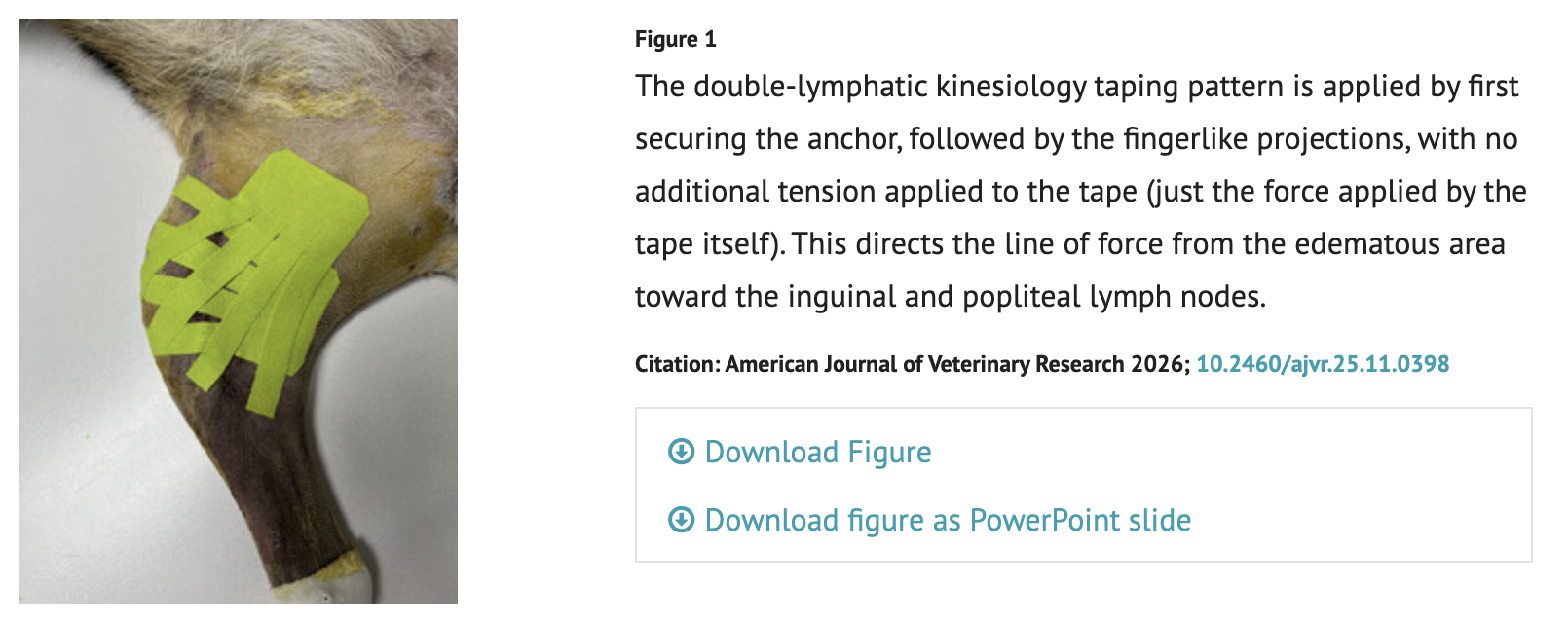
In the February 2026 issue of the American Journal of Veterinary Research, Brittany Ludwig and colleagues present a compelling randomized controlled study on the use of kinesiology taping (KT) to mitigate stifle joint swelling in dogs following tibial plateau-leveling osteotomy (TPLO). This procedure, a staple for treating cranial cruciate ligament rupture in canines, often results in significant postoperative edema during the early inflammatory phase. The authors hypothesized that applying KT in a double-lymphatic pattern immediately after surgery would significantly reduce swelling within 24 hours compared to no taping.
Study Design and Methods
The prospective study enrolled 31 canine stifles from October 2023 to June 2025, randomized into treatment (n=16) and control (n=15) groups. All dogs underwent standard TPLO with consistent anesthetic and pain management protocols, including dexmedetomidine, butorphanol, ketamine, midazolam, meloxicam, and bupivacaine. Girth measurements were taken using a pressure-sensitive tape at three key sites: the lateral fabella (LF), joint line (JL), and tibial tuberosity (TT). Assessments occurred preoperatively and at 0, 3, 18, and 24 hours postoperatively.
For the treatment group, veterinary-specific KT was applied medially in a double-lymphatic fan pattern using the "paper-off" technique (10-15% baseline elongation), directing lymphatic flow toward popliteal and inguinal nodes. No adverse effects from the tape were reported, and it remained in place for 24 hours.
Key Findings
The treatment group exhibited significantly less swelling at the LF site at 18 and 24 hours, and at the TT site at 3, 18, and 24 hours postoperatively. No significant differences were noted at the JL site. These results support KT's efficacy in enhancing lymphatic drainage and reducing soft tissue distension, aligning with prior human and equine studies on edema control.
Implications for Veterinary Practice
This research highlights KT as a simple, low-cost, noninvasive adjunct to postoperative care for TPLO patients. By promoting skin lifting and fluid passage, it could minimize discomfort and accelerate recovery in the critical first day. While the study is limited to short-term outcomes and a small sample, it paves the way for broader adoption in canine orthopedics. Practitioners specializing in sports medicine or rehabilitation may find this particularly valuable for optimizing patient outcomes.
And now you know!
Until next time…
Cheers! Laurie