Laurie's Blogs.

Feb 2026
Soft Tissue Sarcomas
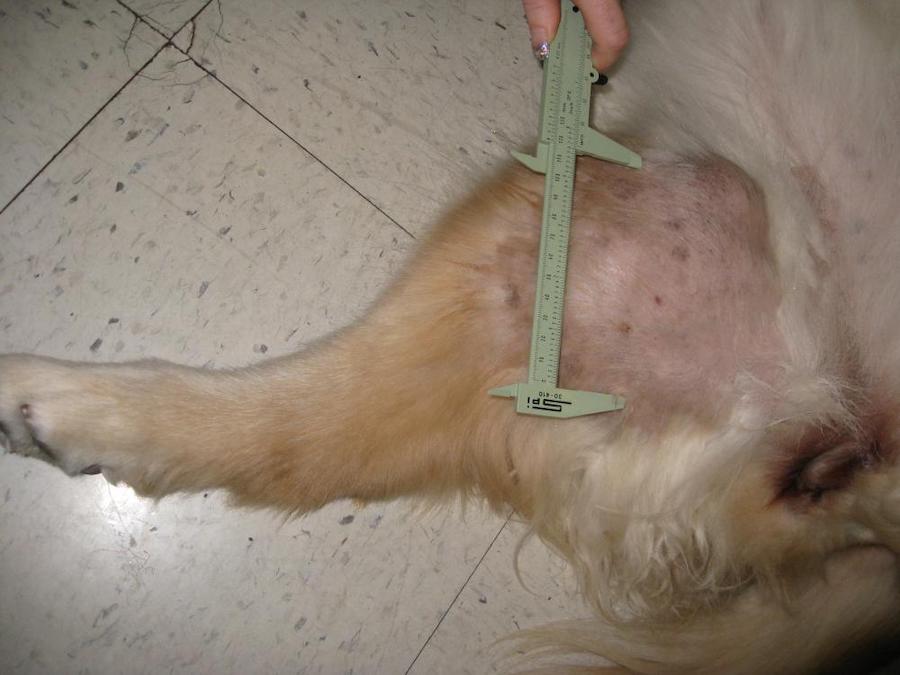
Picture from:
https://www.merckvetmanual.com/integumentary-system/tumors-of-the-skin-and-soft-tissues/undifferentiated-and-anaplastic-sarcomas-in-animals
I had a returning patient come in recently for his monthly physio tune-up. He’s an older hunting dog and has arthritis pretty much everywhere, as well as some lumbosacral pain that I treat. He’s been radiographed and evaluated at his family vet, and managed medically from that standpoint.
This time around, the owner said he was not doing great. He was lame on a back leg, more so than any time previously – just toe touching in a stance, and partially weight bearing when walking. I set about my evaluation. His distal thigh was enlarged, proximal to the stifle (which has arthritis, but was NOT more tender or more restricted in movement). I could palpate the popliteal lymph node easily although it wasn’t excessively enlarged, it was ‘easier to find’. The enlarged region of the thigh was tight, and on pushing into it, tender as well.
I alerted the owner to my concern that the lump has the potential to be cancerous. She was planning on stopping in at her vet to get more pain medication on her way home anyways, and so she was going to book an appointment when she was there, or see if her vet could fit her in on the same day. When she left my clinic, I called the vet to discuss my concerns. Fast forward and the dog was able to see the vet, who agreed with my concerns.
While this isn’t good news, my intention of sharing this story is to highlight to other rehab practitioners / veterinary physiotherapists the red flags that led to my concern. In this case, the feel of the leg, the increase in lameness, and the sudden deterioration in standing weight bearing were most troubling to me.
More Information
I did a series of AI searches on “clinical signs of a soft tissue sarcoma” to round out this blog and provide readers with additional clinical signs and symptoms to take into consideration should a “rehabilitation case” come across your path that doesn’t quite feel right!
Clinical Signs of Soft Tissue Sarcoma in a Dog's Leg
Soft tissue sarcomas (STS) in dogs are tumors that arise from connective tissues, muscles, or nerves, and when located in the leg, they often present as a lump or mass under the skin.
These tumors can vary in texture, appearing firm and attached to underlying structures or softer and more movable, and they may grow slowly or rapidly.
Key clinical signs specific to STS in a dog's leg include:
- Visible or palpable mass/lump: Often the first noticeable sign, appearing as a firm to semi-firm swelling on or under the skin of the leg, which may be non-painful initially.
- Limping or lameness: Due to the tumor interfering with normal movement, causing difficulty walking or ambulating as the mass grows or obstructs the limb.
- Pain or tenderness: Dogs may yelp, pull away when the area is touched, or show discomfort, especially if the tumor compresses nerves or muscles.
- Swelling in the limb: Obvious enlargement or inflammation around the tumor site, which can make the leg appear distorted.
- Ulceration or skin breakdown: In advanced cases, the skin over the tumor may break open, leading to infection or further pain.
These signs are typically related to the primary tumor rather than metastasis, as STS in dogs tends to be locally invasive but metastasizes slowly.
If you notice any of these in your own dog or canine patient, consult a veterinarian for diagnosis, as early detection improves outcomes.
Clinical signs of a soft tissue sarcoma in people
Soft tissue sarcomas are often asymptomatic in their early stages because the body’s elastic tissues can easily shift to accommodate a growing tumor. Symptoms typically appear only once the tumor becomes large enough to press on nearby nerves, muscles, or organs.
1. Primary Warning Signs
The most characteristic sign is a lump or mass. Look for a lump that is:
- Growing: Increasing in size over weeks or months.
- Large: Greater than 5 cm (roughly the size of a golf ball).
- Firm and Fixed: Feels solid and doesn't move easily under the skin, unlike a soft, fatty lipoma.
- Painless at first: Many people wait to see a doctor because the lump doesn't hurt, but pain often only develops later as it presses on nerves.
2. Location-Specific Symptoms
Symptoms vary significantly depending on where the sarcoma originates:
- Arms and Legs: Swelling in the affected limb, restricted range of motion in nearby joints, and deep, aching pain.
- Abdomen/Retroperitoneum: A feeling of fullness, persistent abdominal or back pain, and potential constipation.
- Digestive Tract (GIST): Nausea, vomiting, and blood in the stool (which may appear black or tarry).
- Chest: Difficulty breathing, coughing, or chest pain.
- Uterus: Unusual vaginal bleeding or pelvic discomfort.
3. Advanced or Systemic Signs
As the cancer progresses, it may cause more generalized symptoms:
- Unexplained weight loss.
- Persistent fatigue.
- Lymphedema: Swelling caused by lymph fluid buildup if the tumor blocks lymph vessels.
- Skin Changes: Discoloration, puckering, or open sores if the tumor breaks through the skin.
Wrap Up
The case I highlight at the beginning of this blog is not the first soft tissue sarcoma that I have referred back to veterinary care. There is a high probability that one of these cases will cross your ‘rehab path’ at some point in your career. It’s important to know what to look for, and what clinical signs should be ringing those alarm bells in your head!
Until next time,
Cheers. Laurie
Veterinary References
- Cornell University College of Veterinary Medicine. "Soft tissue sarcomas in dogs." https://www.vet.cornell.edu/departments-centers-and-institutes/riney-canine-health-center/canine-health-information/soft-tissue-sarcomas-dogs
- NC State Veterinary Hospital. "Medical Oncology: Canine Soft Tissue Sarcoma." https://hospital.cvm.ncsu.edu/services/small-animals/cancer-oncology/oncology/canine-soft-tissue-sarcoma
- VCA Animal Hospitals. "Soft Tissue Sarcomas." https://vcahospitals.com/know-your-pet/soft-tissue-sarcomas
- PetMD. "Soft Tissue Sarcoma in Dogs." https://www.petmd.com/dog/conditions/cancer/soft-tissue-sarcoma-dogs
- The Animal Medical Center. "Soft Tissue Sarcomas in Dogs." https://www.amcny.org/pet_health_library/soft-tissue-sarcomas-in-dogs
- PetCure Oncology. "Soft Tissue Sarcomas In Dogs." https://petcureoncology.com/soft-tissue-sarcomas-in-dogs
Human References
- American Cancer Society. (2018, April 6). Signs and symptoms of soft tissue sarcomas. American Cancer Society
- Canadian Cancer Society. (n.d.). Symptoms of soft tissue sarcoma. Canadian Cancer Society
- Cleveland Clinic. (2022, May 27). Sarcoma: What it is, symptoms & treatment. Cleveland Clinic
- Gronchi, A., Miah, A. B., Dei Tos, A. P., Abellan, N., Blay, J. Y., Ferrari, S., ... & ESMO Guidelines Committee. (2021). Soft tissue and visceral sarcomas: ESMO–EURACAN–GENTURIS Clinical Practice Guidelines for diagnosis, treatment and follow-up. Annals of Oncology, 32(11), 1347-1365. ScienceDirect
- Johnson, W. C., & Strauss, J. (2022). Soft tissue sarcoma: Recognizing a rare disease. Cleveland Clinic Journal of Medicine, 89(2), 73-77. Cleveland Clinic Journal of Medicine
- Lawrence, W., Jr., & Donegan, W. L. (2008). Predicting malignancy in soft tissue masses: Size still matters. Annals of Surgical Oncology, 15(1), 32-33. PubMed Central
- Mayo Clinic. (2024, December 4). Soft tissue sarcoma - Symptoms and causes. Mayo Clinic
- National Cancer Institute. (2023, June 2). Soft tissue sarcoma treatment (PDQ®)–Patient version. NCI - National Institutes of Health